Pull up three real estate sites for Burleith right now and you will get three different median prices. One shows $2.0 million for the three months ending in March 2026. Another puts the figure at $2,142,500 through early 2026. A third, tracking active listings in August, shows a median list price under $1.9 million. None of these sources is wrong. Burleith sells fewer than 30 rowhouses in a typical year, which means a single $3 million closing or a single distressed sale can swing the "median" enough to make three accurate snapshots look like three different markets.
That instability is worth knowing before you set a budget. But it is not the interesting part of Burleith right now. The interesting part is why the range is so wide in the first place, and the answer traces back to a community vote in 2018 that most buyers touring the neighborhood today have never heard of.
What $1.2 Million Buys Versus What $3 Million Buys
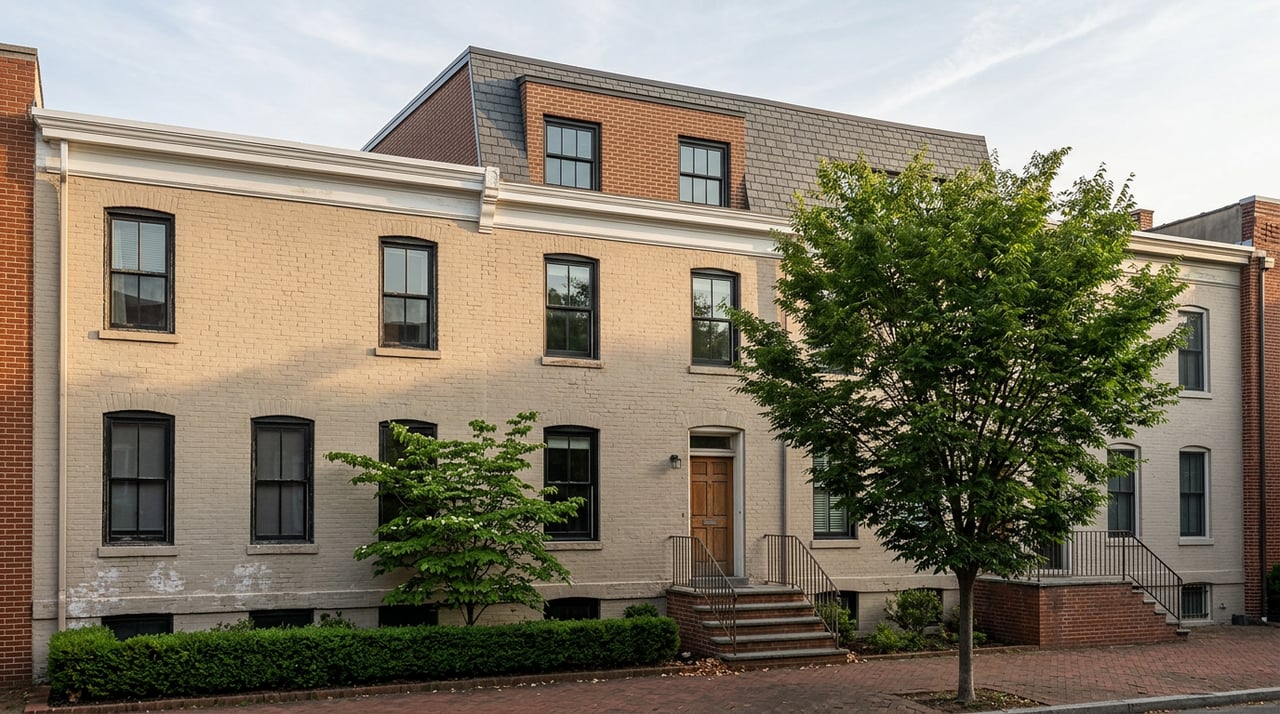
Shannon & Luchs built Burleith's original housing stock between 1923 and 1928: compact, three-story Colonial Revival rowhouses running roughly 1,300 to 1,400 square feet above grade, marketed at the time to buyers of modest means but genuine taste. Those homes, in original or lightly updated condition, are still what most of Burleith's inventory looks like, and they still trade in a fairly narrow band. The Burleith Citizens Association's own market notes put unrenovated stock in the $1.2 million to $1.3 million range, with anything priced in the $800,000s to $1.2 million usually snapped up by developers before it reaches a full listing cycle.
Then there is the other Burleith. In May 2026, a rowhouse at 3726 R St NW sold for $3,230,000, five bedrooms and 4,265 square feet. In March, 3636 S St NW closed at $3,025,000 with six bedrooms across 3,314 square feet. Also in May, 3402 R St NW sold for $3,000,000. As of early August, two more homes carrying the same profile, a five-bedroom at 3554 T St NW listed at $2,995,000 with 3,720 square feet, and one on Reservoir Road at $2,799,900 with 3,404 square feet, sat on the market at the same tier.
The pattern connecting all five: none of them started as 3,300-square-foot houses. They started as the same 1,300-square-foot Shannon & Luchs rowhouses everyone else on the block owns. A developer added a third floor, dug out or extended the rear, and roughly doubled or tripled the livable space. The Citizens Association describes this directly: third-floor pop-ups are now selling in the $2.5 million to $3.5 million range, pushing the neighborhood's average sale price past $2.05 million in 2025 and putting Burleith third among DC neighborhoods with a median home price over $1 million, according to UrbanTurf's rankings.
That is not a story about finishes or staging. It is a story about how much additional square footage the neighborhood will let you build, and how fast.
The Vote Nobody Outside Burleith Remembers
In 2016, the Burleith Citizens Association formed a committee to study whether the neighborhood should pursue historic district designation, the same status held by more than 30 DC neighborhoods including Foxhall Village, Cleveland Park, and Capitol Hill. The process ran for two years: town halls, a Neighborhood Study Group, a public meeting with the DC Preservation League on what permitting actually costs in a historic district. The Association posted an open survey to residents in June 2018. When results came back that September, they showed clear opposition to designation.
Burleith stayed undesignated. Practically, that means renovation and addition projects here go through DC's standard permitting process, reviewed by the Department of Buildings for zoning and code compliance, with no historic preservation design review of massing, materials, or street-facing changes. A pop-up in Burleith needs to satisfy the same permit review as a pop-up anywhere else in the District. It does not need a preservation committee to sign off on whether a third floor changes the character of the block.
Why This Matters More in Burleith Than It Would Elsewhere
Here is the part that surprises people who assume "historic district" is the whole story: even if Burleith's 2018 vote had gone the other way, it still would not have faced Georgetown's level of scrutiny. The Association's own materials are explicit about this. A Burleith historic district would have looked like Foxhall Village's, not Georgetown's, because Georgetown answers to something Burleith never would have: the Old Georgetown Board, created by an Act of Congress in 1950. That board's review sits on top of DC's standard Historic Preservation Review Board process and is, by the Association's own description, generally more restrictive.
So the real gap is not "historic versus not historic." It is that Georgetown carries two layers of review, city and federal, while Burleith, whether or not it had voted for designation, would have carried at most one. The 2018 vote removed even that one. A developer buying on R Street or S Street in Burleith is working with a permitting timeline and design flexibility that a developer buying two blocks south, inside the Old Georgetown Act boundary, simply does not have. Same architecture era, same brick and mansard-roof vocabulary, materially different math on what you're allowed to build and how long it takes to get there.
What This Means If You're Looking at Burleith Right Now
If you are comparing Burleith to Georgetown on the assumption that "Georgetown-adjacent" means similar renovation rules, adjust that assumption. The regulatory environment is genuinely different, not just the price per square foot.
If you are the buyer eyeing one of the $1.2 million to $1.3 million originals with renovation plans, the addition math above is your ceiling reference, not your budget. A $2.5 million to $3.5 million pop-up resale price includes construction, financing carry, and the developer's margin, not just materials.
If you are the buyer or investor looking at a home that has already been expanded, ask when the addition was permitted and finaled, and confirm the work matches what the Department of Buildings has on record. A pop-up done properly through standard permitting is a different asset than one where the paperwork lags the construction.
And if you're watching days on market as your read on urgency, know that the number has moved a lot in the past year. Homes that sold in roughly two weeks in early 2025 were taking closer to ten to thirteen weeks by early 2026 in some tracking, which is a real shift in leverage, not noise. Given how few transactions Burleith produces annually, treat any single data point, including this one, as a signal to verify against current listings rather than a fixed rule.
One more distinction worth making before you tour: Hillandale, the gated enclave of roughly 268 homes on Burleith's western edge, is a different product entirely. Built in the 1980s on a former sheep farm, with a pool, tennis courts, and 24/7 security, its townhomes and detached houses sell in their own range and shouldn't be compared directly to the Shannon & Luchs rowhouse stock a few streets over.
A Few Direct Questions
Is Burleith a historic district? No. Residents considered it for two years and voted against pursuing designation in 2018, so renovations go through standard DC zoning and building permit review rather than a preservation design review.
Does that mean I can build whatever I want? No. You still need to satisfy DC's zoning regulations and building code through the Department of Buildings, and the Board of Zoning Adjustment handles any variance requests. What you're skipping is the additional aesthetic and materials review that historic districts, and especially Georgetown's federally chartered Old Georgetown Board, apply on top of that.
Why do I see such different median prices for Burleith depending on the site? Volume. Burleith sells under 30 homes most years, so the mix of what closed in any given quarter, whether it happened to include a $1.2 million original or a $3.2 million pop-up, moves the median more than it would in a higher-volume neighborhood. Look at the underlying sales, not just the summary number.
If you're weighing a Burleith rowhouse against a Georgetown one, or trying to figure out what a specific block's addition history says about resale potential, that is exactly the kind of read Mike Aubrey and the team spend their time on. Get in touch and we'll walk the comparison with you, block by block.
This article is general information, not legal, tax or financial advice. Consult a qualified professional about your situation.