If you are looking for a Northwest DC neighborhood that feels quiet, green, and distinctly residential, Spring Valley stands out fast. You may be weighing architecture, lot size, day-to-day convenience, and whether the neighborhood feels tucked away without feeling disconnected. This guide will help you understand what makes Spring Valley different, from its housing style to its yards and everyday rhythm. Let’s dive in.
What Defines Spring Valley
Spring Valley sits in upper Northwest DC within Ward 3, where neighborhood planning has long centered on residential areas grouped around local commercial nodes. What makes Spring Valley especially notable is that it is more single-family-home oriented than some nearby Ward 3 neighborhoods that include denser apartment and townhouse pockets.
Its general boundaries are often described around Massachusetts Avenue, American University, Nebraska Avenue and Loughboro Road, and Dalecarlia Parkway. That placement helps explain why the neighborhood can feel tucked away even though it remains close to major corridors and everyday services.
Spring Valley's Architectural Identity
Planned from the start
Spring Valley was developed by W.C. and A.N. Miller in 1929 as a planned community. Historic documentation describes it as a neighborhood of detached single-family homes with large private yards, landscaped streets, parks, and community-centered planning.
That origin matters because the neighborhood was not built around DC’s more familiar rowhouse grid. Instead, its street pattern was adjusted to follow the terrain, which gives Spring Valley a more winding, estate-like layout and a softer visual feel as you move through it.
Revival styles shape the streetscape
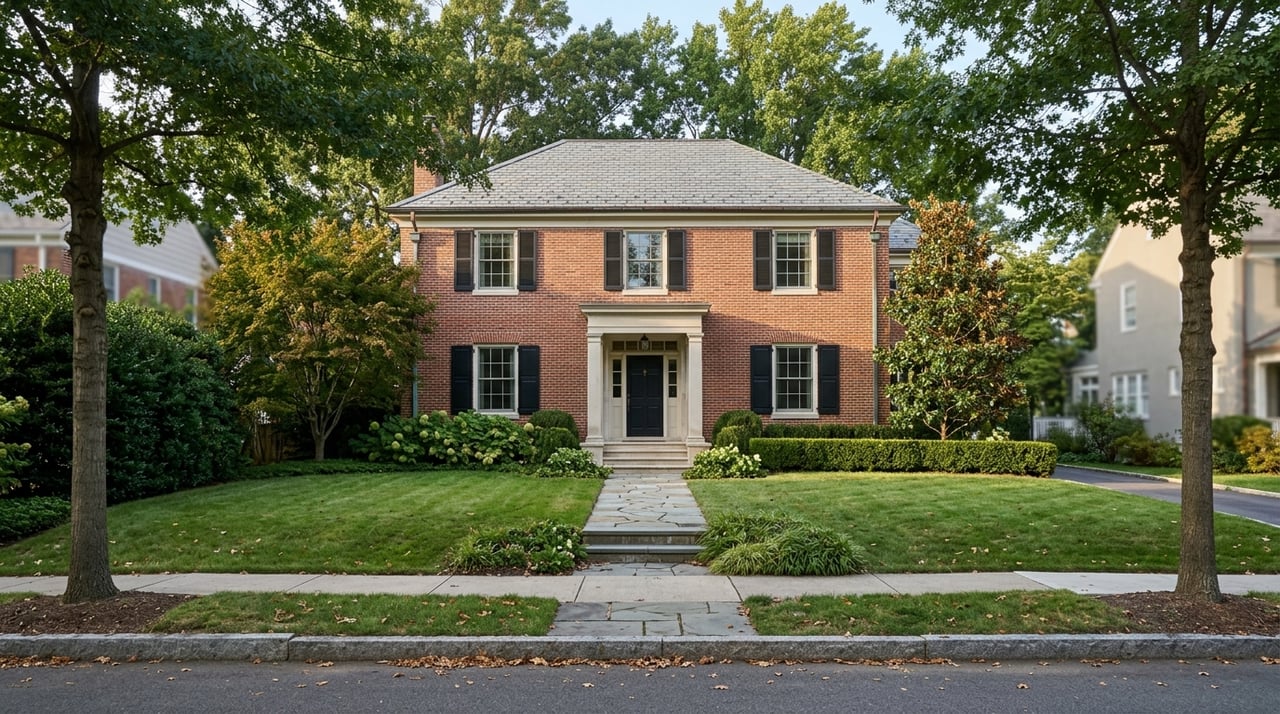
Spring Valley is overwhelmingly associated with Colonial Revival architecture, according to DC Historic Preservation Office documentation. In the broader Miller-built context, revival styles also include English Revival, Tudor Revival, and Classical Revival influences.
In practical terms, that means you will see a traditional architectural language rather than one uniform house type. Many homes reflect classic proportions, brick or stone facades, gabled roofs, and two-story forms that create a cohesive look without making the neighborhood feel repetitive.
Traditional, but not one-note
One of Spring Valley’s strengths is that the homes tend to share a clear visual vocabulary while still offering variety. Historic documentation tied to the Miller neighborhoods notes many two-story, five-bay homes, often with brick or stone-faced exteriors.
For buyers, that can translate into a neighborhood that feels architecturally consistent and established. For sellers, it means home presentation often benefits from highlighting both the traditional structure of the house and the way it sits on its lot.
Why the Yards Feel Different Here
Large private yards are part of the plan
In Spring Valley, larger yards are not just a happy accident. They are part of the neighborhood’s original design, which centered detached homes on spacious lots with landscaped surroundings.
That planning choice still shapes the experience of the neighborhood today. If outdoor space matters to you, Spring Valley offers one of the clearest examples in DC of a residential setting where the house-to-yard relationship is central to the neighborhood identity.
Terrain and trees add character
Historic documentation describes rolling contours, abundant large trees, and streams as part of Spring Valley’s physical character. Those natural features help create the green backdrop that many buyers notice right away.
Because the streets follow the terrain rather than a rigid grid, the landscape feels more organic. The result is a neighborhood atmosphere that reads as quiet and established, with a more estate-like setting than many other DC residential areas.
Open space supports the neighborhood feel
Spring Valley Park and Spring Valley Run are important pieces of the local setting. The District Department of Energy and Environment says Spring Valley Run flows through Spring Valley Park, and a stream restoration completed in 2019 improved trail access and recreation.
That matters because the green character here is not limited to private lots. Public open space and restored natural features add to the neighborhood’s day-to-day livability and reinforce the calm residential feel.
What Daily Life Looks Like
A purposeful retail core
Spring Valley does not revolve around a long commercial strip. Instead, its shopping and errands are concentrated in a neighborhood commercial node that was intentionally planned to serve nearby residents.
The Ward 3 heritage guide explains that local shops were created to provide groceries, pharmacies, and other services without requiring a trip downtown. The Spring Valley Shopping Center opened in 1953 as a planned cluster of neighborhood commercial buildings designed to complement the surrounding homes.
Errands stay simple
Today, the Spring Valley Shopping Center at 4851 Massachusetts Avenue NW includes tenants such as Wagshal's, Wagshal's Delicatessen, Wagshal's Market, CVS, Playa Bowls, and Wells Fargo. Regency Centers also notes that the property includes one of the area’s few surface parking options.
For you, that can make routine stops easier and quicker. In a city where convenience often depends on block-by-block logistics, a compact shopping center with practical parking can be a meaningful lifestyle advantage.
Quiet does not mean isolated
American University is another nearby anchor. AU’s Spring Valley Building is about a mile from the main campus, and the university notes a shuttle connection to Tenleytown or Spring Valley.
That nearby institutional presence adds another layer of accessibility to the area. Spring Valley can feel calm and residential while still remaining connected to broader Northwest DC activity and services.
Who Spring Valley Appeals To
Spring Valley often appeals to buyers who want a detached-home setting in DC and place real value on lot size, mature trees, and a more traditional neighborhood layout. It can also attract those who appreciate classic architecture and want a residential environment that feels distinct from denser rowhouse neighborhoods.
For sellers, the neighborhood’s value story often centers on a combination of housing form, architectural consistency, and land. In a market where micro-location can significantly shape demand, Spring Valley’s planned character and green setting are major parts of its appeal.
What Buyers Should Notice
If you are comparing Spring Valley to other Northwest DC neighborhoods, focus on the physical qualities that are hardest to recreate. In this neighborhood, those often include detached housing, larger private yards, mature landscaping, and a traditional streetscape shaped by topography rather than a strict grid.
You should also pay attention to how close a home is to the neighborhood shopping center, major corridors, and open space. In a neighborhood like Spring Valley, small location differences can influence both daily convenience and the feel of the immediate surroundings.
What Sellers Should Highlight
If you own a home in Spring Valley, your property story should usually go beyond square footage alone. Buyers are often responding to the total setting, including the architecture, the lot, the trees, the street presence, and the neighborhood’s established character.
That means strong positioning often starts with the home's relationship to its site. Details like yard depth, landscaping, exterior materials, and how the house fits within the neighborhood’s traditional architectural language can all matter in how buyers perceive value.
Why Spring Valley Holds Its Own
Spring Valley offers a version of DC living that feels intentionally residential. Its 1929 planning history, detached homes, large yards, revival-style architecture, and green backdrop combine to create a neighborhood experience that is different from the city’s more common rowhouse pattern.
At the same time, it still provides practical convenience through its neighborhood retail center and proximity to American University and major Northwest routes. If you want a Northwest DC neighborhood where architecture, land, and lifestyle all work together, Spring Valley deserves a close look.
If you are considering buying or selling in Spring Valley, working with a team that understands how architecture, lot characteristics, and micro-location shape value can give you a sharper edge. For tailored guidance and a high-touch strategy, connect with The Mike Aubrey Group.
FAQs
What kind of homes are most common in Spring Valley, DC?
- Spring Valley was planned around detached single-family homes with large private yards, making that the neighborhood’s defining housing type.
What architectural styles define Spring Valley in Northwest DC?
- Spring Valley is overwhelmingly Colonial Revival in character, with other revival-style influences in the broader Miller-built context, including English Revival, Tudor Revival, and Classical Revival.
Does Spring Valley, DC have larger yards than other neighborhoods?
- Large private yards are one of Spring Valley’s most distinguishing features because they were part of the neighborhood’s original planned design.
What shopping is available in Spring Valley, DC?
- The Spring Valley Shopping Center includes tenants such as Wagshal's, Wagshal's Delicatessen, Wagshal's Market, CVS, Playa Bowls, and Wells Fargo.
Is Spring Valley, DC close to parks and green space?
- Yes. Spring Valley Park and Spring Valley Run are part of the neighborhood’s character, and stream restoration work completed in 2019 improved trail access and recreation.
How would you describe the lifestyle in Spring Valley, DC?
- Spring Valley offers a quiet, lower-density residential feel with traditional homes, mature trees, purposeful neighborhood retail, and access to nearby Northwest DC services.